

TTYL meaning: it stands for “talk to you later.” It’s a casual sign-off used in texts, DMs, and chat apps to end a conversation without saying a hard goodbye — it signals “I have to go now, but we’ll pick this up again soon.” It’s not rude, it’s not final, and it works the same whether it’s typed in caps or lowercase.
Table of Contents
- TTYL Meaning Explained
- Where Did TTYL Come From?
- How to Use TTYL in a Text or Chat
- TTYL on Snapchat, Instagram, WhatsApp, and TikTok
- Is TTYL Unprofessional?
- How to Reply to TTYL
- TTYL vs BRB vs GTG vs AFK
- Does TTYL Mean Anything Else?
- Is It Rude to Say TTYL and Not Text Back?
- How Other Languages Say “Talk Later”
- FAQs
TTYL Meaning Explained {#what-does-ttyl-mean}
TTYL meaning is a texting abbreviation for “talk to you later.” It’s used to close out a conversation casually — you’re stepping away, but you’re not ending the relationship or the topic for good.
It works as a full reply on its own (“TTYL!”) or tacked onto the end of a longer message (“Gotta run, TTYL”). Capitalization doesn’t change the meaning — TTYL, Ttyl, and ttyl are all read the same way, though lowercase is more common among younger texters.
Where Did TTYL Come From? {#where-did-ttyl-come-from}
TTYL is a product of the internet chatroom era, not modern texting. It first spread through IRC and early chatrooms in the late 1980s and 1990s, when typing fast mattered more than typing correctly.
A 1993 Boston Globe piece already listed “ttyl” alongside other early internet shorthand like ROTFL and AFK — proof it was mainstream slang well before smartphones existed. It picked up serious momentum in the late 1990s and early 2000s through instant messengers like AIM, ICQ, and MSN Messenger, where 160-character SMS limits and slow numeric keypads made every saved keystroke worth it.
Urban Dictionary documented it by 2002, and the Oxford English Dictionary added “ttyl” as an official entry in 2016 — a strong sign it had moved from internet slang to standard English.
How to Use TTYL in a Text or Chat {#how-to-use-ttyl}
The direct answer: drop TTYL at the end of a message when you’re wrapping up a conversation but plan to continue it later. Here’s what that looks like in practice.
| Situation | Example message |
|---|---|
| Ending a text casually | “Anyway I gotta go walk the dog, TTYL!” |
| Phone dying | “My phone’s about to die, I’ll TTYL” |
| Mid-task | “Boss just called me in, ttyl 😊” |
| Standalone sign-off | “TTYL!” |
| Confirming a follow-up | “Cool, talk tonight — TTYL” |
Pair it with an emoji (👋, 😊) in casual or friendly contexts to soften it further, though it doesn’t need one to read as friendly.
TTYL on Snapchat, Instagram, WhatsApp, and TikTok {#ttyl-on-social-media}
TTYL meaning stays the same everywhere, but the weight of it changes slightly by platform.
On Snapchat, it usually means the streak or chat is paused, not ended — expect a reply later that day. On Instagram DMs and TikTok comments, it’s often used lightly, even jokingly, since conversations there are less time-sensitive. On WhatsApp, where conversations tend to be more personal (family, close friends), TTYL more often means a real, near-term callback.
Given how much of daily messaging now happens inside these apps rather than SMS, this platform context matters more than the phrase itself. Pew Research’s December 2025 teen study found that 36% of U.S. teens use at least one major platform (YouTube, TikTok, Instagram, or Snapchat) “almost constantly,” with roughly a quarter also active on WhatsApp — which is exactly why quick sign-offs like TTYL still get so much daily use in 2026, even with voice notes and reactions on the rise.
Is TTYL Unprofessional? {#ttyl-at-work}
Short answer on TTYL meaning at work: keep it out of work email and formal client messages, but it’s fine in internal team chat with people you’re casual with (Slack, WhatsApp group with close coworkers).
The reasoning is simple — TTYL reads as informal because it is informal slang, and formal channels (client emails, first messages to a new manager, official documentation) call for “I’ll follow up later” or “talking soon” instead. Use your judgment based on how casual the relationship already is, not the platform.
How to Reply to TTYL {#how-to-reply}
There’s no wrong reply to TTYL meaning “see you later” — it doesn’t require a long response, just an acknowledgment.
- To a friend: “Okay, ttyl!” or just an emoji (👋)
- To a crush or partner: “Can’t wait, talk soon 💕” or “Miss you already, ttyl”
- To a coworker: “Sounds good, talk later” (skip the abbreviation in work chat)
- If you want to keep talking: “Wait, one more thing before you go —”
If someone doesn’t reply to your TTYL, don’t read too much into it — see the etiquette section below.
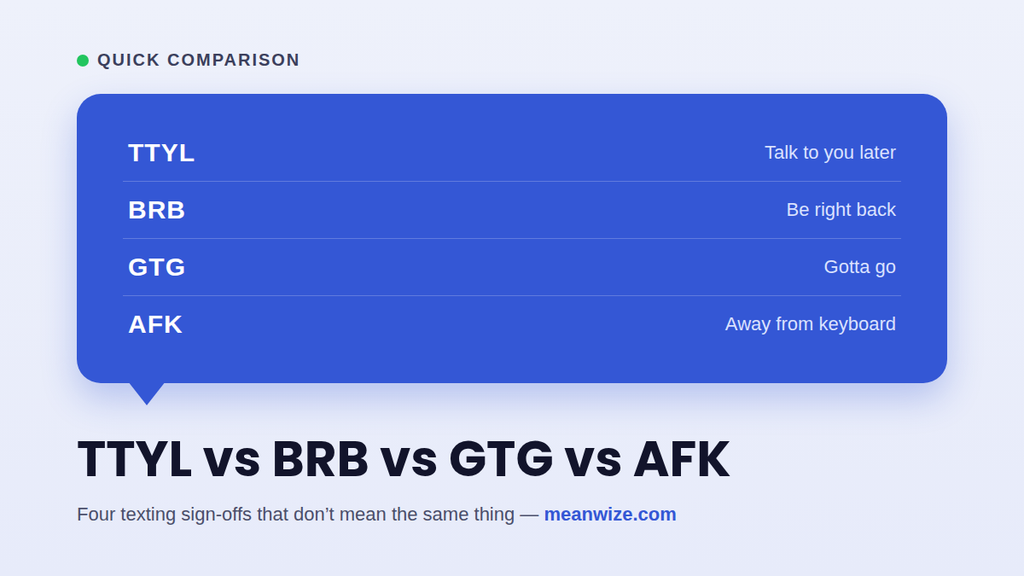
TTYL vs BRB vs GTG vs AFK {#comparison-table}
These four get mixed up constantly. Here’s the actual difference:
| Abbreviation | Means | Implies you’ll be back… |
|---|---|---|
| TTYL | Talk to you later | Later today, or another day — no fixed time |
| BRB | Be right back | Within minutes — you’re still “there,” just stepping away |
| GTG | Got to go | Right now, and possibly not returning to this chat |
| AFK | Away from keyboard | Temporarily, usually gaming/voice-chat context |
The simplest way to remember it: BRB is a pause, GTG is an exit, and TTYL is a “see you next time” — it’s the only one of the three that’s explicitly about a future conversation rather than the current one. Curious about other chat shorthand? Our SMH meaning guide breaks down another one you’ll see constantly.
Does TTYL Mean Anything Else? {#other-meanings}
Outside of texting, TTYL has no established meaning in physics, medicine, aviation, or any technical field — if you’ve seen it used that way, it’s almost certainly a typo, a niche in-house abbreviation, or unrelated to the texting slang. In everyday digital communication, “talk to you later” is the only meaning you need to know.
Is It Rude to Say TTYL and Not Text Back? {#etiquette}
No — TTYL is a soft, non-binding sign-off, not a promise with a deadline. It buys both people room to step away without an explicit “goodbye,” which is exactly why it’s lasted this long as slang.
That said, if someone says TTYL and then doesn’t respond for days, that’s a separate issue from the phrase itself — it’s a communication gap, not something TTYL caused. If timing matters (you need an answer today), it’s better to say so directly rather than relying on TTYL to imply urgency it doesn’t carry.
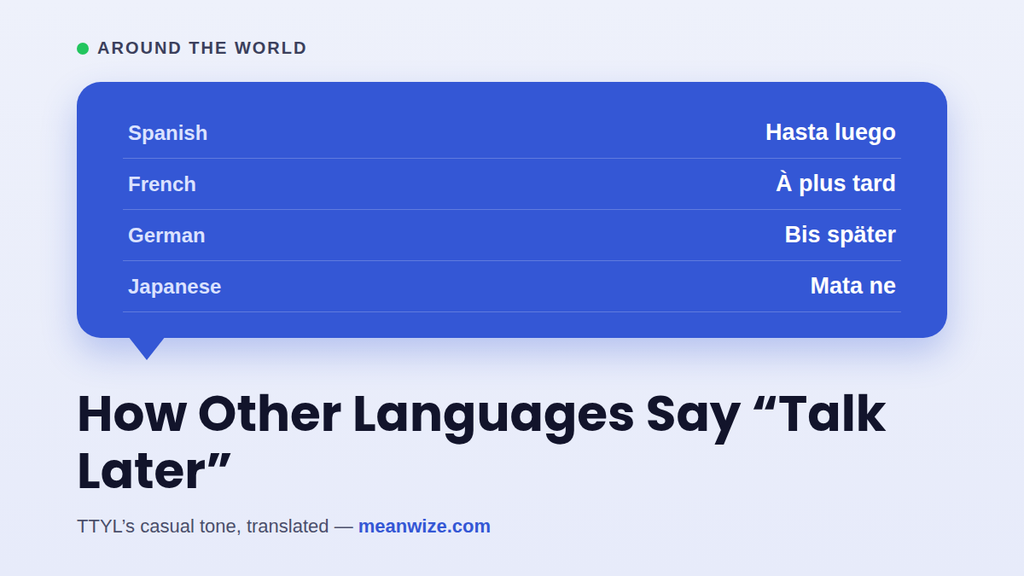
How Other Languages Say “Talk Later” {#international}
The TTYL meaning doesn’t always translate directly into other languages, but the sign-off itself is universal. A few common equivalents seen in international chats:
| Language | Common shorthand/phrase |
|---|---|
| Spanish | “Hablamos luego” or “Nos vemos” |
| French | “On se parle plus tard” or “À plus” (A+) |
| Portuguese | “Falamos depois” |
| Tagalog/Filipino | “Chat tayo mamaya” |
Most non-English messaging cultures use the full phrase rather than a single-letter abbreviation like TTYL — English is unusually acronym-heavy in texting compared to most other languages.
Related slang: If you found this helpful, also check our guide on AFK meaning in text.
FAQs {#faqs}
What is the TTYL meaning in a text?
TTYL meaning: “talk to you later.” It’s used to end a conversation casually when you plan to continue it another time.
Is TTYL the same as goodbye?
Not exactly. “Goodbye” can sound final; TTYL specifically implies the conversation will continue later, making it softer and more casual.
What does TTYL mean from a girl (or guy) texting you?
The same thing it means from anyone — “talk to you later.” Tone comes from context (emojis, punctuation, prior conversation), not from who sent it.
Is TTYL still used in 2026?
Yes. It remains one of the most recognized texting abbreviations across age groups, especially in casual chat, Snapchat, and group texts.
What’s the difference between TTYL and TTYS?
TTYS means “talk to you soon,” implying a shorter gap than TTYL, which doesn’t specify a timeframe at all.
Can I use TTYL at work?
Avoid it in formal emails or with clients; it’s fine in casual internal chat with coworkers you’re friendly with.
Who invented TTYL?
No single person — it developed organically in 1990s internet chatrooms and instant messengers, the same way most texting slang formed.
Conclusion
TTYL meaning has stuck around since the 1990s chatroom era for one reason: it does a specific job — a casual, low-pressure way to pause a conversation — better than any full sentence does. Whether you’re texting a friend, replying on Snapchat, or wrapping up a WhatsApp chat, TTYL still means exactly what it did thirty years ago: talk to you later.
Want the full picture of texting shorthand? Check out our FR meaning guide next, or see what WYD means in a text and how it compares to TTYL.

2 thoughts on “TTYL Meaning: What Does TTYL Mean in Text?”