

Quick answer: The shook meaning has two sides. In standard English, shook is the past tense of “shake” (“She shook the bottle”). In slang, being shook means you are shocked, stunned, scared or emotionally overwhelmed by something (“That ending left me shook”).
If someone texts “I’m shook,” they are telling you something hit them hard. It can be good news, bad news, a scare or a moment that moved them. The context tells you which shook meaning they intend.
This guide covers every shook meaning, how to tell them apart, the grammar rules, where the slang came from, and how to reply when a friend says it.
Pronunciation: /ʃʊk/ — rhymes with book, look and cook.
What Does Shook Mean in Slang?
The slang shook meaning in one line: shook is an adjective that means strongly affected by something unexpected. It is not one fixed emotion. It covers a range, from pure shock to fear to happy tears.
Merriam-Webster lists separate slang senses for shocked or surprised, overcome with emotion, and frightened or intimidated. In everyday use, excitement is a fourth shade that shows up constantly on social media.
| Shade of “shook” | What the person feels | Example |
|---|---|---|
| Shocked / stunned | Disbelief, “I did not see that coming” | “They broke up after eight years? I’m shook.” |
| Scared / rattled | Fear, nerves, feeling unsafe | “A car ran the red light right in front of me. I’m still shook.” |
| Emotionally moved | Touched, close to tears | “My dad drove six hours to see my graduation. I was shook.” |
| Excited / amazed | Thrilled, blown away in a good way | “Front-row tickets?! I’m literally shook.” |
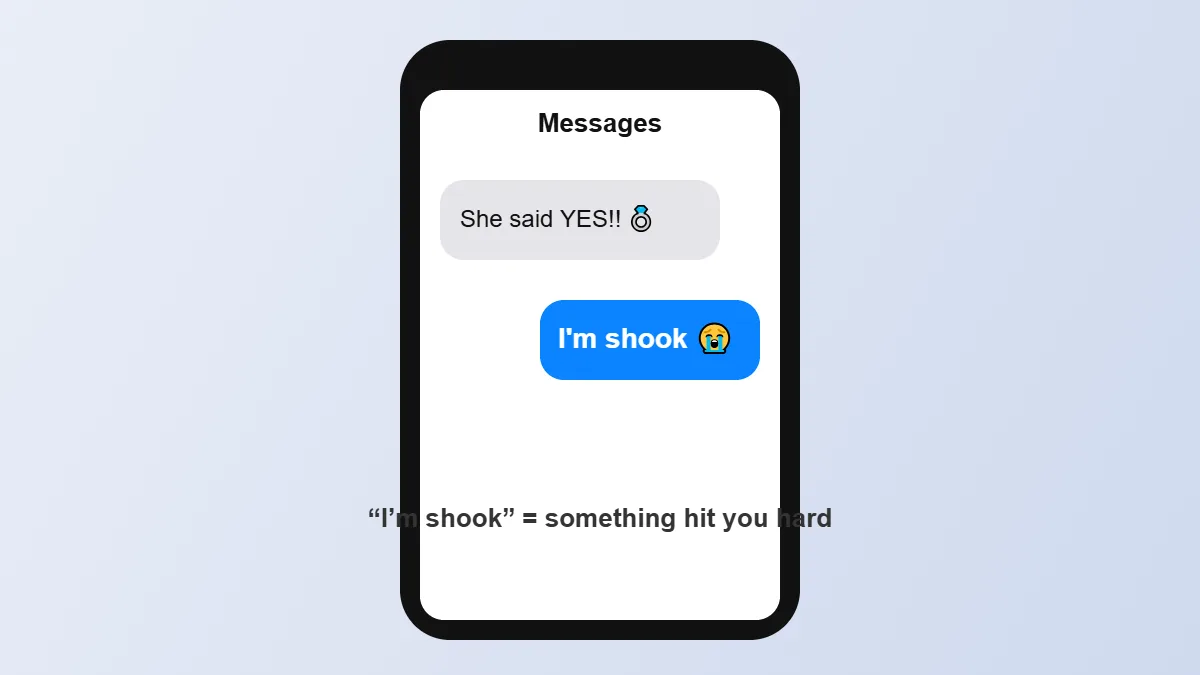
The common thread is intensity. You would not say “I’m shook” because your coffee was slightly cold. You say it when a moment actually rattles you, or when you want to sound dramatic for fun.
Online, people often stretch it for effect: so shook, lowkey shook, shook to my core, or the joke version shooketh.
How to Tell Which Shook Meaning Someone Intends
Look at what caused it and the words around it. The same word can mean “I’m thrilled” or “I’m terrified,” so the trigger and the tone decide the meaning.
| Clue in the message | Likely meaning | Example |
|---|---|---|
| Good news, gifts, wins, celebrity sightings | Excited or amazed | “I got the job!!! Shook 😭” |
| Accidents, near misses, scary movies | Scared or rattled | “That jump scare had me shook” |
| Plot twists, gossip, surprising facts | Shocked | “Wait, octopuses have three hearts? Shook.” |
| Kind gestures, family moments, speeches | Emotionally moved | “Her wedding speech left the whole room shook” |
| “You’re not shook?” / “He ain’t shook” | Afraid or intimidated (often in sports or rap) | “The defense looked shook in the second half” |
Tip: Emojis help a lot. 😭 or 🥹 usually signals happy or moved. 😱 or 😳 usually signals shock or fear. If you still can’t tell, just ask: “Good shook or bad shook?”
Shook Meaning as the Past Tense of Shake
In standard English, shook is the simple past tense of the verb shake. It describes something that was physically moved back and forth, or someone who was emotionally disturbed, in the past.
- “He shook the bottle before opening it.”
- “The earthquake shook the whole building.”
- “They shook hands and signed the deal.”
- “The news shook the entire town.”
The verb shake is irregular, so its forms don’t follow the usual -ed pattern:
| Form | Word | Example |
|---|---|---|
| Base | shake | “Shake the jar well.” |
| Simple past | shook | “I shook the jar.” |
| Past participle | shaken | “I have shaken the jar.” |
| Present participle | shaking | “I am shaking the jar.” |
| Not a word | Never correct |
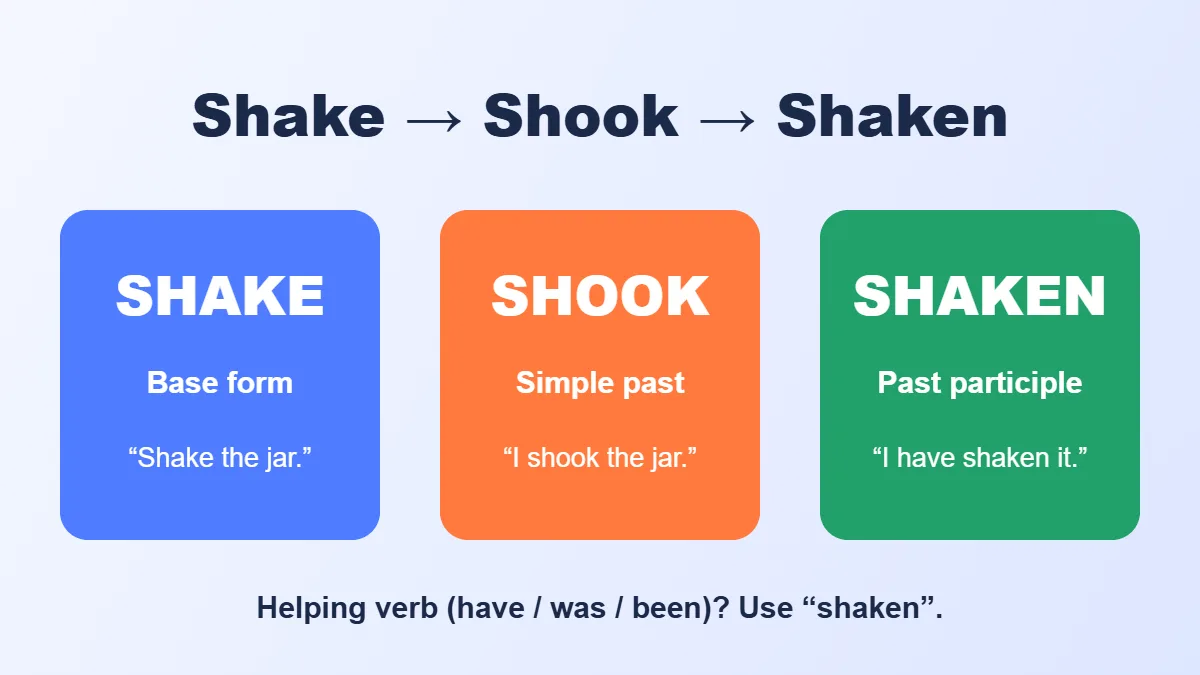
Easy rule: if there is a helping verb (have, has, had, was, is, been), formal English uses shaken. With no helping verb, use shook. Writer’s Digest explains the same shook vs shaken rule with more examples.
- Correct: “She shook the tree.”
- Correct: “She had shaken the tree.”
- Incorrect (formal): “She had shook the tree.”
Is “I’m Shook” Grammatically Correct?
In formal English, no. In informal English and slang, yes, and dictionaries now record it. Traditional grammar says it should be “I’m shaken,” because an adjective after am/is/was normally uses the past participle.
But slang doesn’t follow textbook rules, and shook as an adjective is very old. Merriam-Webster dates its first known use as an adjective to 1854, and it appears in classic novels like Treasure Island (1883). Both Merriam-Webster and Dictionary.com now list the slang meaning.
So the honest answer depends on where you are writing:
| Setting | “I’m shook” | Better choice |
|---|---|---|
| Texts, social media, chatting with friends | ✅ Natural | — |
| Casual blog or video caption | ✅ Fine | — |
| School essay, exam, job application | ❌ Avoid | “I was shocked” / “I was shaken” |
| Work email, report, legal writing | ❌ Avoid | “The news was unsettling” |
Think of it like gonna: everyone understands it, but it doesn’t belong in formal writing.
Where Does “Shook” Come From?
The slang “shook” is not new internet slang. It is a 170-year-old use of an Old English word that hip-hop and social media made popular again. Here is how it travelled:
| When | What happened |
|---|---|
| Old English | Shake comes from Old English sceacan, meaning to move quickly back and forth. Shook has been its past tense ever since. |
| 1854 | Merriam-Webster’s first recorded use of shook as an adjective meaning nervously upset. |
| 1800s | Shook also worked as slang for “drunk” among some Australian, Irish and American speakers. |
| 1883 | Robert Louis Stevenson uses shook as an adjective in Treasure Island, in a pirate’s dialect. |
| 1897 | Rudyard Kipling uses “shook up” in Captains Courageous, an early print example of the phrase. |
| 1995 | New York rap duo Mobb Deep release “Shook Ones,” where shook means scared or weak. The word becomes a hip-hop staple. |
| 2010s | Shook spreads on Twitter, Tumblr and Instagram as a reaction to anything surprising. |
| 2017 | Comedian Christine Sydelko says “I am shooketh” in a YouTube video, and shooketh becomes a meme. |
| Today | Common in texts, TikTok captions and everyday speech, especially among Gen Z and millennials. |
The fear-based sense (“he ain’t shook”) comes from African American English, and dictionaries credit it as the source of the modern slang. Hip-hop carried it into mainstream culture, and the internet then widened it to cover happy surprise too. Social media has pushed plenty of newer slang the same way, from rizz to delulu.
Why “shooketh”? The -eth ending copies old Bible-style English (he loveth, he maketh). Adding it makes the reaction sound over-the-top and funny, as if the shock were of biblical size.
Shook vs Shocked vs Shaken vs Shook Up
These words overlap, but they differ in tone and formality. Shocked and shaken are safe everywhere. Shook and shook up are casual.
| Word | Meaning | Tone | Example |
|---|---|---|---|
| Shook | Stunned, rattled, moved or thrilled | Slang, very casual | “That finale had me shook.” |
| Shocked | Surprised by something unexpected, often bad | Neutral, works anywhere | “I was shocked by the results.” |
| Shaken | Upset or disturbed, usually after something scary | Neutral to formal | “She was shaken after the accident.” |
| Shook up | Upset or disturbed; also “to shake up” means to change things | Informal | “He’s pretty shook up about the news.” |
| Shooketh | Extremely shocked, said as a joke | Playful meme slang | “The price of eggs? I’m shooketh.” |
Key difference: shocked is mostly about surprise. Shook can also carry fear, excitement or deep emotion, which is why people use it for everything from horror films to proposals.
Common Phrases With Shook
Most shook phrases come from the verb shake, and many are perfectly formal.
- Shook hands — greeted someone or sealed a deal. “We shook hands on the price.”
- Shook his/her head — signalled no, disbelief or disapproval. “She shook her head and walked away.”
- Shook off — got rid of something unwanted. “He shook off the cold in two days.”
- Shook it off — ignored criticism or a setback. “She heard the rumours and shook it off.”
- Shook to the core — deeply disturbed at the most personal level. “The betrayal shook him to the core.”
- Shook like a leaf — trembled with fear or nerves. “Before her first speech, she shook like a leaf.”
- Shook things up — made big changes. “The new manager really shook things up.”
- Shook the world — had a huge impact. “The discovery shook the scientific world.”
The Rare Noun Shook Meaning
As a noun, a shook is a set of wooden parts ready to be assembled, usually the staves of a barrel. This is a trade term from timber and cooperage, recorded since the late 1700s.
For example, a barrel maker might ship a shook of staves and headings so it can be put together on arrival. Dictionaries also list an older farming sense: a group of sheaves stood up together in a field, similar to a shock of wheat.
You will rarely hear this today, but it explains why dictionaries show shook as a noun.
How to Reply When Someone Says “I’m Shook”
Once you know the shook meaning they intend, match their emotion first, then ask what happened. “I’m shook” is an invitation to react, so a flat “ok” can feel cold.
| They are shook because… | Good replies |
|---|---|
| Something great happened | “No way, congrats!!” · “Wait, tell me everything” · “You deserve it” |
| Something scary happened | “Are you okay?” · “That sounds terrifying, where are you now?” |
| Shocking news or gossip | “WHAT 😳” · “I’m shook too” · “Since when??” |
| A sad or emotional moment | “That’s so sweet” · “Okay now I’m crying too” |
| You can’t tell | “Good shook or bad shook?” |
If the person sounds genuinely frightened, for example after an accident, skip the jokes and check on them properly.
When You Should Not Use “Shook”
Avoid “shook” in any writing where you need to sound professional or correct. It is slang, and some readers will see it as a grammar mistake.
- School and exams: write shocked, shaken or stunned.
- Work emails and reports: “The delay was unexpected” works better than “We’re shook.”
- Serious situations: after a real tragedy, shook can sound too light. “Deeply shaken” shows more respect.
- Older or international audiences: some may not know the slang and will read it as broken English.
On the other hand, in texts, comments and captions, shook sounds more natural and expressive than the formal options.
Shook Meaning in Urdu and Hindi
The shook meaning in Urdu and Hindi changes with the sense. The verb shook means ہلایا (hilaya) in Urdu and हिलाया (hilaya) in Hindi. The slang shook means حیران (hairan) / हैरान (hairan), or “in shock.”
| English use | Urdu | Hindi | Roman Urdu / Hinglish |
|---|---|---|---|
| He shook the bottle | اس نے بوتل ہلائی | उसने बोतल हिलाई | Us ne bottle hilai |
| I’m shook (shocked) | میں حیران رہ گیا / گئی | मैं हैरान रह गया / गई | Main hairan reh gaya |
| I’m shook (scared) | میں ڈر گیا / گئی | मैं डर गया / गई | Main dar gaya |
| I’m shook (emotional) | میں جذباتی ہو گیا / گئی | मैं भावुक हो गया / गई | Main emotional ho gaya |
| Shook to the core | اندر تک ہل گیا | अंदर तक हिल गया | Andar tak hil gaya |
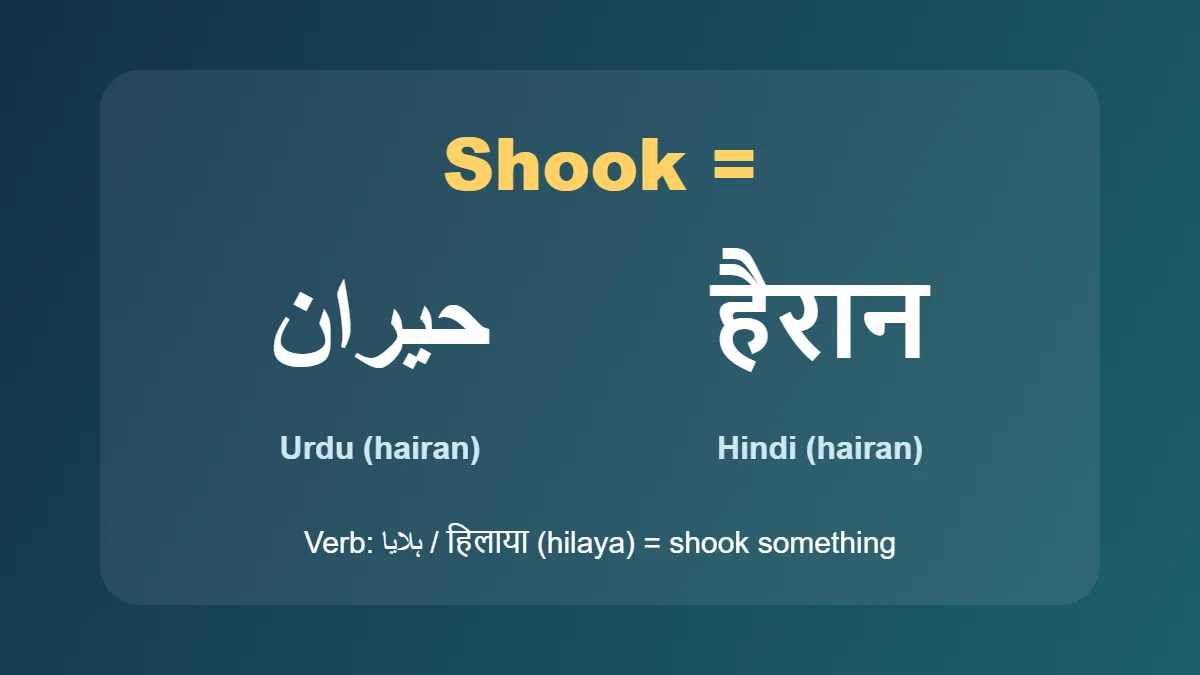
A close everyday match is “dimagh hil gaya” or “sadme mein hoon”. Like English shook, these phrases can describe surprise, fear or a strong emotional hit, depending on context.
Synonyms and Opposites of Shook
Pick a synonym based on which shade of “shook” you mean.
| Meaning | Synonyms | Opposites |
|---|---|---|
| Shocked | stunned, speechless, floored, blown away, gobsmacked | unsurprised, expecting it |
| Scared | rattled, spooked, shaken, unnerved | calm, fearless, unbothered |
| Emotionally moved | touched, overwhelmed, choked up | unmoved, indifferent |
| Excited | thrilled, amazed, hyped, over the moon | bored, unimpressed |
| Past tense verb | trembled, quivered, vibrated, rattled, wobbled | held still, steadied |
The best all-purpose opposite in slang is unbothered or unfazed: someone who stays calm no matter what happens.
Quick Self-Test
Which meaning of shook is used in each sentence? Answers are below.
- “The dog shook water all over the kitchen.”
- “I saw my exam score and I’m still shook. I passed!”
- “That thunder was so loud, I’m shook.”
- “The factory received a shook of oak staves.”
- “She shook her head and said nothing.”
Answers: 1) past tense verb · 2) slang, excited · 3) slang, scared · 4) noun, barrel parts · 5) past tense verb, body gesture
Frequently Asked Questions
What is the shook meaning in text?
In a text, shook means the sender is shocked, stunned or emotionally hit by something. It can be positive (“I got in! I’m shook”) or negative (“He lied? Shook”). Look at the news they shared and any emojis to know which.
Is “shook” a bad word?
No. Shook is not rude or offensive. It is just informal. It’s fine with friends and on social media but out of place in formal writing.
What does “you got me shook” mean?
It means “you surprised me” or “you scared me.” People say it after a prank, a jump scare, or unexpected news from the other person.
What does “shooketh” mean?
Shooketh is a joke form of shook that means extremely shocked. The old-style -eth ending makes the reaction sound dramatic. It went viral in 2017 after a YouTube video.
Is it “I was shook” or “I was shaken”?
In formal English, say “I was shaken.” In casual speech and slang, “I was shook” is common and widely understood, and dictionaries now record it.
Can “shook” mean happy?
Yes. Shook can describe happy surprise or excitement, such as getting a gift, meeting a celebrity or hearing great news. The context makes the mood clear.
What is the past tense of shake?
The simple past is shook (“I shook it”). The past participle is shaken (“I have shaken it”). Shaked is not a word.
Conclusion
The full shook meaning comes down to one word doing two very different jobs. In standard English it is the past tense of shake. In slang it means something hit you hard, whether that is shock, fear, joy or a lump in your throat.
Use it freely in texts and captions, read the context to know which feeling someone means, and switch to shocked or shaken when you need to sound formal.
Keep learning: Explore more slang and everyday word meanings on Meanwize. Start with our guides to sus meaning in text and brainrot meaning, or browse all word meanings, so the next text you get never leaves you confused.
