

Quick answer: POV means “point of view.” In texts, it is used to share your opinion or your side of a story, like “my pov: we should leave early.” On TikTok and Reels, a caption that starts with “POV:” puts you inside a scene, so the video plays out as if you are the person in that moment, for example “POV: you forgot your homework.”
Scroll through TikTok or Instagram Reels for more than thirty seconds and you’ll almost certainly run into a caption that starts with three letters: POV. It shows up on relatable skits, dramatic reenactments, dating app bios, gaming clips, and even in group chats where someone drops a single “POV:” before describing their Monday morning. But what does POV meaning actually , where did it come from, and why has it become one of the most versatile pieces of internet shorthand in 2026?
This guide breaks down everything you need to know about POV — its dictionary definition, its internet slang meaning, how it’s used across WhatsApp, Instagram, TikTok, and Snapchat, and how it shows up outside social media in film, psychology, gaming, and even the military. By the end, you’ll be able to use POV correctly in any context — and understand exactly what someone means when they drop it in your DMs.
POV Meaning & Definition
Primary POV Meaning
At its core, POV is an abbreviation for Point of View. In its most traditional sense, it describes the perspective, angle, or vantage point from which something is seen, told, or experienced. This is the definition you’ll find in most dictionaries, including Cambridge Dictionary, which defines it as an abbreviation used to refer to a particular person’s opinion or way of viewing something.
In film, literature, and photography, POV refers to whose eyes the audience is seeing through. A “POV shot,” for example, shows exactly what a character sees, as if the camera lens is their own eyes.
Secondary POV Meaning (Internet Use)
On social media, POV has evolved into something slightly different — and arguably more powerful. Instead of simply describing a viewpoint, it’s used as an invitation. When a creator writes “POV:” at the start of a caption or video, they’re essentially saying: imagine you are in this exact situation right now. It places the viewer directly inside a scenario rather than having them watch it as a bystander.
This shift matters. The internet version of POV isn’t just descriptive — it’s immersive and second-person. It pulls the audience into the moment instead of narrating events at them.
Explore more meaning on my website meanwize.
Examples
| Context | Example Usage | Meaning |
|---|---|---|
| Traditional | “The story is told from the POV of a child.” | Perspective/narrative viewpoint |
| Social media | “POV: you’re the last one to find out the group trip got cancelled.” | Puts viewer in the scenario |
| Chat/texting | “Just my POV, but I’d wait before replying.” | My opinion/take |
| Gaming | “Check out this POV gameplay clip.” | First-person camera view |
Background & Origin of POV
Traditional Use
POV has been part of English vocabulary for decades, long before social media existed. It originated in filmmaking and literary criticism as a way to describe narrative perspective — first-person, third-person, omniscient, and so on. Photographers and videographers also used it to describe a specific camera technique: a shot filmed to represent what a character or subject is seeing in real time.
Digital Evolution of POV Meaning
The internet took this cinematic and literary term and repurposed it for short-form storytelling. As Reels, TikToks, and Snaps grew in the early 2020s, creators needed a fast, universal way to signal “imagine this is happening to you.” POV became that shortcut. It originally emerged in cinema, photography, and literature to indicate scenes told from a specific character’s perspective, and creators simply borrowed that established meaning and applied it to relatable, everyday micro-scenarios — behind-the-scenes moments, comedic skits, and emotional storytelling condensed into 15-second clips.
By the mid-2020s, POV had fully detached from needing an actual camera perspective. A static photo, a meme, or even plain text can now carry a “POV:” caption, because the term has come to represent a narrative framing device rather than a literal filming technique.
Usage in Different Contexts
POV doesn’t mean exactly the same thing everywhere it appears. Here’s how it shifts depending on where you encounter it.
1. POV Meaning on Social Media Content
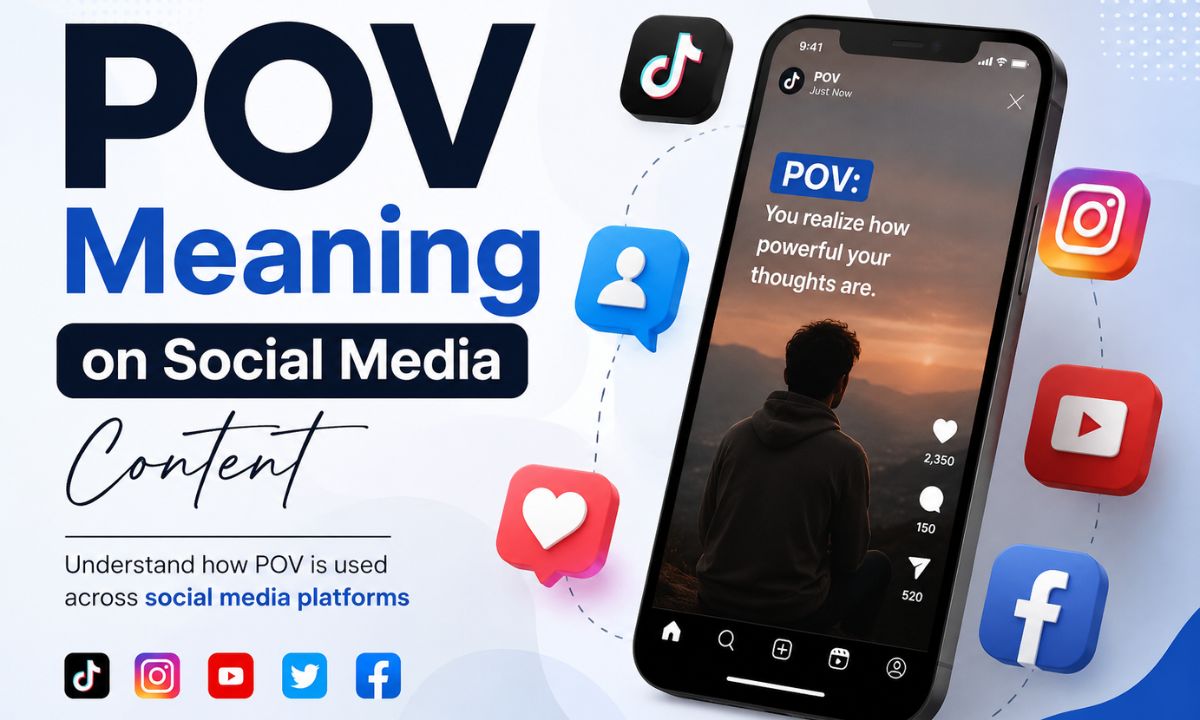
This is where POV is most recognizable today. Creators use it to set up a scenario the viewer is meant to picture themselves inside — often paired with music, acting, or a relatable caption. It works because it feels personal rather than observational; instead of watching someone else’s day, you’re being told this is your day.
2. POV Meaning in Chat Conversations
In one-on-one texting or group chats, POV is often shortened even further into a purely opinion-based phrase. Someone might type “POV, I think we should just cancel” — here it functions almost identically to “IMO” (in my opinion) or “the way I see it.”
3. POV Meaning in Storytelling & Memes
Meme culture uses POV to set up a joke or an ironic scenario in a single line, usually paired with an image or GIF that reinforces the punchline. It’s a fast, format-friendly way to build a relatable “you had to be there” moment without any actual video.
4. POV Meaning in Gaming Community
Among gamers, POV usually refers to literal first-person camera footage — a “POV clip” is gameplay recorded from a specific player’s in-game perspective, often shared to showcase a skillful play, a funny moment, or a controversial call during a match.
Meanings Across Platforms (WhatsApp, Instagram, TikTok, Snapchat)
While the core meaning of POV stays consistent, the way it’s used varies slightly by platform.
On WhatsApp, POV is used more conversationally than visually. It tends to appear as a quick text prefix in a chat or status update — for example, a WhatsApp status might read “POV: your mom just found your report card.” Since WhatsApp doesn’t have the same short-video culture as TikTok, POV here leans closer to its “opinion” or “imagine this” usage in plain text.
Instagram uses POV heavily across Reels, Stories, and captions. It’s common to see a Reel captioned “POV: you finally get invited to the girls’ trip,” paired with a short acted-out clip. Instagram creators also use POV in carousel captions and photo dumps to add a storytelling layer to otherwise static content.
TikTok
TikTok is widely credited as the platform that turned POV into a mainstream trend. It’s used constantly across skits, roleplay content, comedic bits, and emotional storytelling. A POV video on TikTok is typically a short, scripted scene filmed as if the viewer is a character within it — the barista, the ex, the sibling, the pet, and so on.
Snapchat
On Snapchat, POV shows up in Snap captions and Stories, often used more casually and briefly than on TikTok. Because Snapchat content is typically shared with close friends rather than a public audience, POV captions here tend to be inside jokes or day-to-day relatable moments rather than polished, scripted skits.
| Platform | Typical Format | Common Style |
|---|---|---|
| Text status, chat message | Conversational, opinion-based | |
| Reels, Stories, captions | Storytelling, aesthetic | |
| TikTok | Short-form video, skits | Scripted, acted-out scenarios |
| Snapchat | Snaps, Stories | Casual, in-the-moment |
For further reading on platform-specific usage, see how people search for POV meaning in reels, POV meaning in memes, and POV meaning vehicle — each reflecting a slightly different corner of how the acronym is used online and offline.
Other Fields Where POV is Used
POV isn’t exclusive to social media slang. The term carries specific, well-established meanings in several other industries.
Film & Photography
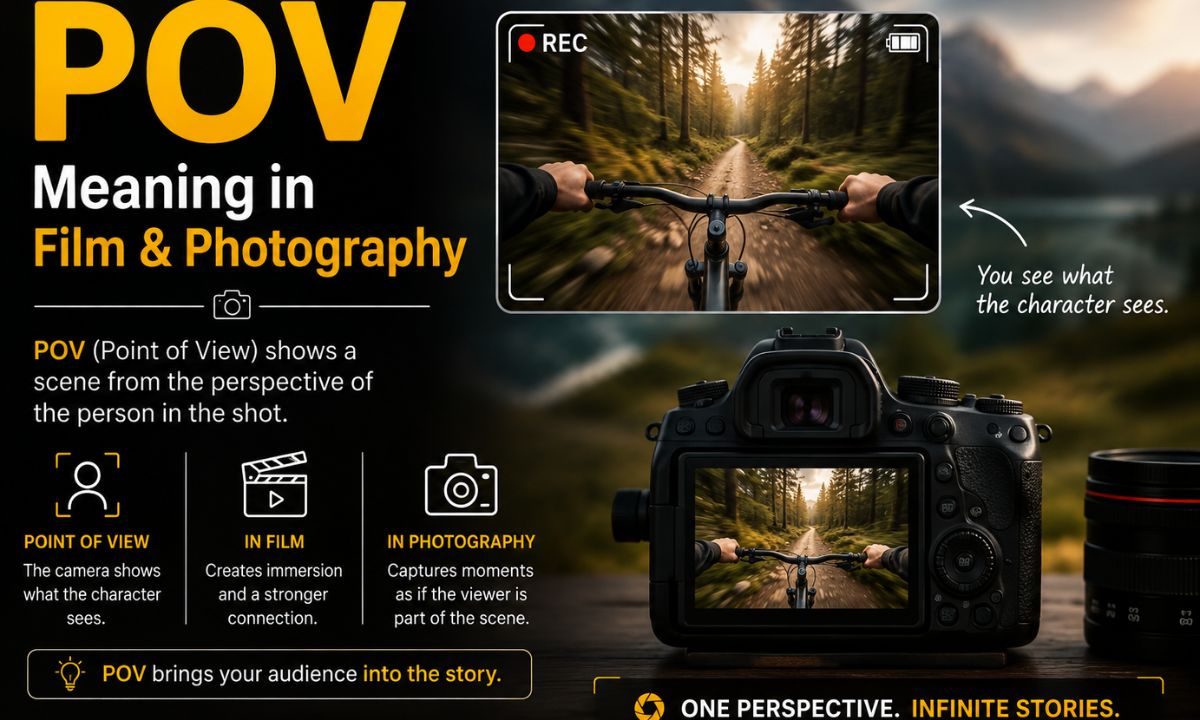
In filmmaking, a POV shot is a specific camera technique that shows the audience exactly what a character sees, mimicking their literal eyeline. It’s used to build immersion, tension, or intimacy with a character’s experience. Photographers use the same concept when composing shots meant to replicate a subject’s field of vision.
Psychology
In psychology and communication studies, “point of view” refers to an individual’s unique perspective shaped by their experiences, beliefs, and cognitive framing. Understanding someone’s POV is central to concepts like empathy, perspective-taking, and cognitive bias — recognizing that two people can witness the same event and walk away with entirely different interpretations.
Automotive & Aviation
Outside of entertainment, POV takes on a completely different meaning in military, government, and logistics contexts: Privately Owned Vehicle. This usage refers to a vehicle owned personally by a service member rather than one issued by the government, and it’s especially relevant during a Permanent Change of Station (PCS), when service members may be eligible to have one POV shipped at government expense. It’s a term you’ll encounter in military orders, vehicle shipping paperwork, and relocation guides rather than casual conversation.
POV Meaning in Science & Technical Fields
In technical and scientific writing, POV can also stand for niche terms depending on the field — such as specific measurement or system references in engineering documentation. Context always determines the correct expansion, which is why acronym-lookup resources list dozens of POV meanings depending on category (military, medical, tech, business, and slang all have their own versions).
Common Misconceptions & Mistakes
Common Mistakes
- Using POV like a caption for a normal, non-immersive video. POV should set up a specific scenario the viewer is meant to imagine — not just label random content.
- Grammatically misusing POV as a stand-alone opinion filler (“POV, I like pizza”) when a full point-of-view scenario isn’t actually being described.
- Assuming POV always means video content. It also works in text, images, and memes.
Misconception
A common misunderstanding is that POV simply means “my opinion” in every context. While it’s sometimes used loosely that way in chats, the internet-native meaning is closer to “here’s the scenario — picture yourself in it,” which is more immersive than a plain opinion statement.
✔ Correct Usage
The correct way to use POV is to follow it with a specific, second-person scenario: “POV: you just realized you left your phone at the restaurant.” This framing places the reader or viewer directly into the moment, which is what makes the format effective and shareable.
Similar Terms & Alternatives
Several other terms overlap with POV but aren’t quite interchangeable:
- IMO / IMHO — “In my opinion” / “in my humble opinion,” used for stating a personal view without the immersive scenario-setting POV implies.
- TBH — “To be honest,” signals candor rather than perspective.
- First-person narrative — the formal literary term for storytelling from an “I” perspective, closely related to POV’s traditional meaning.
- Vantage point — a more formal synonym for point of view, used in writing and analysis.
- Take — informal slang for opinion, as in “what’s your take on this?”
How to Respond to POV in Chats
When someone sends a POV-style message or video, the expected response is usually to react as though you’re actually in the scenario — playing along rather than just commenting from the outside.
Examples
- If a friend sends “POV: you just walked in on your roommate eating your leftovers,” a fitting reply might be an exaggerated reaction like “I would move out immediately.”
- If a POV video shows a stressful work scenario, replying with something like “this is literally me every Monday” keeps the immersive tone going.
- In more casual chat use, where POV is closer to “my take,” a simple agreeing or disagreeing reply works fine, e.g., “honestly, valid POV.”
Differences From Similar Words
POV vs Opinion
An opinion is a direct statement of belief or preference. POV, especially in its internet sense, is broader — it sets up an entire scenario or perspective for someone to step into, rather than just stating a stance.
POV vs Story
A “story” (as in a narrative) can be told from any perspective and covers a full sequence of events. POV specifically indicates whose eyes or experience that story is being filtered through — it’s a lens, not the narrative itself.
POV vs Caption
A regular caption simply describes or comments on a post. A POV caption does more — it instructs the viewer on how to mentally position themselves within the content, which is why POV posts tend to feel more interactive and relatable than standard captions.
Relevance in Online Conversations & Dating Apps
Why it’s used
POV has become especially popular on dating apps and in flirty online conversations because it’s an easy, low-pressure way to create a hypothetical, relatable scenario without directly stating a feeling or intention. It softens vulnerable statements by framing them as a shared imaginative moment rather than a direct confession.
Examples
- A dating app bio might read: “POV: we’re arguing about which pizza topping is superior at 1 a.m.” — a playful way to hint at compatibility and humor.
- In a flirty text exchange, someone might send “POV: I pick you up and we don’t decide where we’re going until we’re already in the car,” using POV to paint a spontaneous, appealing scenario.
- On profiles, POV prompts are also used to invite responses, essentially functioning as a conversation starter disguised as a scene-setter.
Popularity & Trends Over Time
Trend Timeline
| Period | POV Usage Trend |
|---|---|
| Pre-2010s | Primarily technical/literary term (film, photography, writing) |
| Early-to-mid 2010s | Gaming community adopts POV for first-person gameplay clips |
| 2020–2022 | TikTok popularizes POV as a scripted, immersive video trend |
| 2023–2024 | Spreads to Instagram Reels, memes, and everyday chat slang |
| 2025–2026 | Fully mainstream across platforms; used in marketing, dating apps, and brand content |
Why it stays popular
POV content endures because it taps into something fundamental about how people connect online: relatability. Framing a moment in second person makes the audience feel personally involved rather than passively watching, which drives higher engagement, comments, and shares. Brands and marketers have also picked up on this, using POV-style captions in advertising to make products or services feel more personal and less like a sales pitch. As long as short-form video and caption-driven storytelling remain central to social platforms, POV is likely to stay a staple of internet communication rather than fade as a passing trend.
If you want to know more about POV Meaning, see this UrduPoint guide.
Related slang: If you found this helpful, also check our guide on mogging meaning.
FAQs
1. What does POV meaning in text?
In texting, POV usually means “point of view” and is used to introduce a scenario the reader is meant to imagine, or occasionally as shorthand for someone’s personal opinion.
What is POV in Gen Z slang?
For Gen Z, POV is a storytelling device used to set up relatable, second-person scenarios in captions, videos, and memes rather than a literal camera term.
2. Is POV only used on TikTok?
No — while TikTok popularized the modern trend, POV is widely used on Instagram, Snapchat, WhatsApp, gaming platforms, and even in film, military, and psychology contexts.
What is another word for POV?
Common alternatives include “perspective,” “vantage point,” “viewpoint,” or informally “take,” though none fully capture the immersive, second-person style POV has online.
3. Does POV mean opinion?
Not exactly — POV can overlap with opinion in casual chats, but its core meaning is about perspective or framing a scenario, which is broader than simply stating a belief.
4. How do you use POV in a sentence?
Start with “POV:” followed by a specific, second-person scenario, such as “POV: you’re running late and every traffic light turns red.”
5. Why do people use POV captions?
POV captions make content feel personal and immersive, pulling the viewer into the moment instead of having them watch passively, which boosts relatability and engagement.
Conclusion
POV has traveled a long way from its original home in film theory and literary criticism. What once described a technical camera angle or narrative lens is now one of the internet’s most flexible storytelling tools — capable of setting up a joke, a confession, a relatable rant, or a flirty dating app prompt in just three letters. Understanding both its traditional meaning (perspective or viewpoint) and its modern internet usage (an immersive, second-person scenario-setter) will help you use it correctly, whether you’re captioning a Reel, replying in a group chat, or just trying to keep up with how language evolves online. And if you ever come across POV in a completely different setting — like military vehicle paperwork — you’ll now know that context really is everything.

3 thoughts on “POV Meaning: What POV Means in Text and on Social Media”