

KK Meaning: The Complete Guide — Is “KK” Rude? (2026)
If someone replied to your message with just “kk,” you’re probably not being ignored — you’re being agreed with. KK meaning, in almost every chat context, is simple: it’s a doubled-up version of “k” (short for “okay”), used to confirm you understood something and there’s nothing more to say.
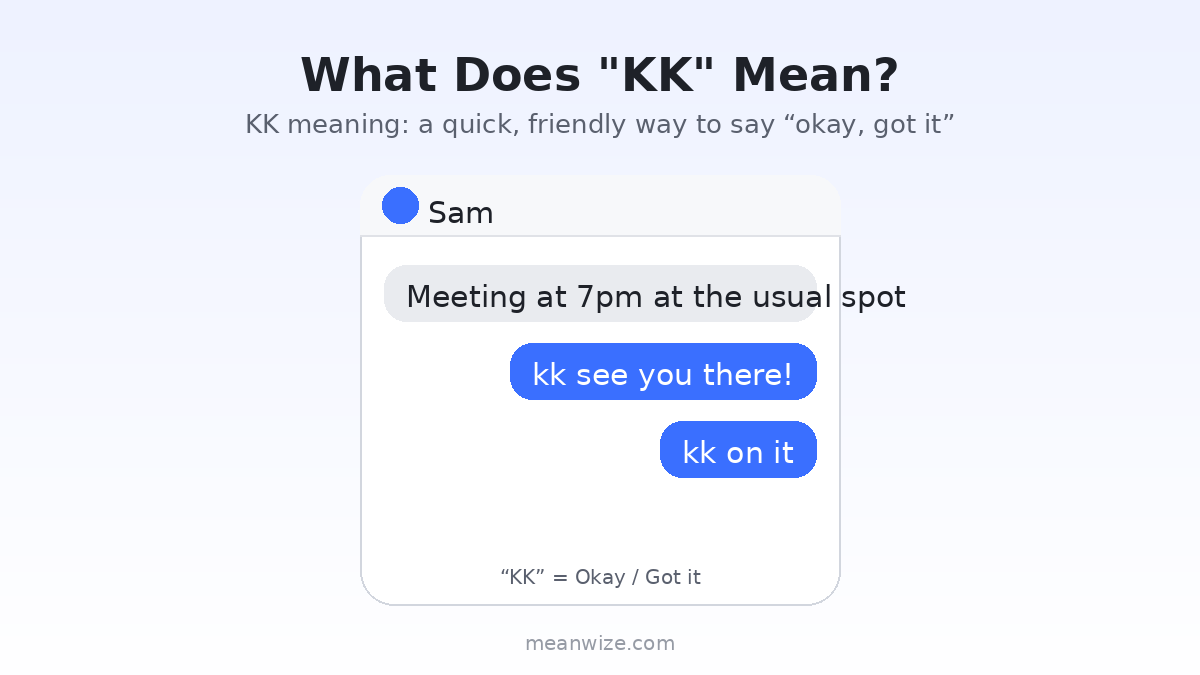
It sounds casual, but “kk” carries more tone than people realize — and outside of texting, the same two letters mean something completely different in gaming, business, and even science. This guide breaks down every KK meaning, where it came from, and when it can come across as rude instead of friendly.
Table of Contents
- What Does KK Stand For?
- Origin and History of KK
- Every KK Meaning, by Context
- Is KK Rude? K vs KK vs OK vs Okay
- How to Use KK Correctly (With Examples)
- Why “KK” Feels Different From Just “OK”
- How to Respond to “KK”
- Common Mistakes to Avoid With “KK”
- Similar Slang Terms to KK
- Does KK Mean the Same Thing on Every App?
- Is KK Still Used in 2026?
- FAQs
What Does KK Stand For?
KK doesn’t stand for a phrase — it’s a doubled letter, not an acronym. It comes from repeating “k” (itself short for “okay”), and the repetition is what changes the meaning.
A single “k” can feel blunt or annoyed. Doubling it to “kk” softens the tone, turning a cold one-letter reply into something closer to “okay, got it — no worries.” That’s why “kk” spread so fast in texting: it’s two extra keystrokes that completely change how a message lands.
Origin and History of KK
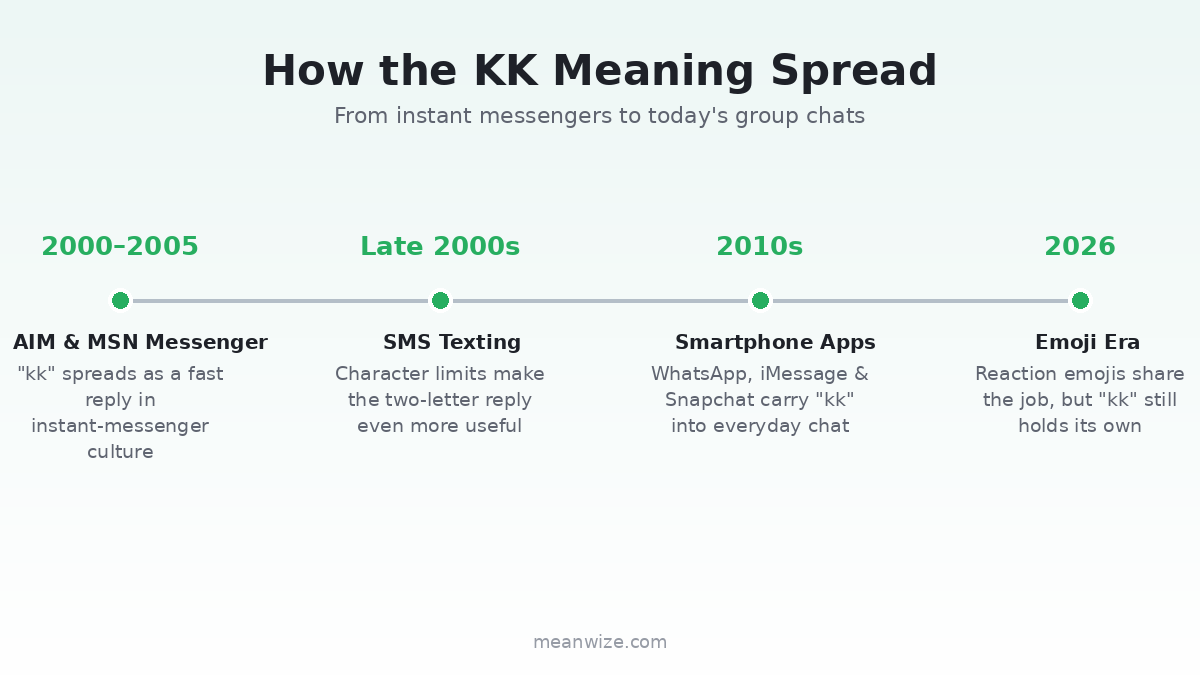
“Kk” as internet slang dates to the early 2000s, growing out of instant messenger culture (AIM, MSN Messenger) before moving into SMS texting and then social apps. Dictionary.com records the term as first appearing in digital use between 2000–2005, and Wiktionary documents the same doubled-letter pattern across other short chat acknowledgments.
The logic behind the KK meaning is simple repetition-for-emphasis, the same pattern seen in slang like “no no” or “yes yes.” As messaging moved from AIM to SMS to today’s apps, “kk” stuck around because it solves a real problem: a single “k” reads as cold, while a full “okay” can feel like overkill for a two-second reply.
Every KK Meaning, by Context
The KK meaning changes slightly depending on where you see it. Here’s every common meaning of KK across texting, gaming, business, and more:
| Context | What KK Means |
|---|---|
| Texting & Chat | “Okay, understood” — a quick, friendly acknowledgment |
| WhatsApp / Instagram / Snapchat / TikTok | Same as texting — confirms plans, often paired with an emoji |
| Online Gaming | “Okay” or “got it” in voice/text chat, used to confirm a call-out or plan |
| Business (Japan) | Short for K.K. or Kabushiki Kaisha, the Japanese equivalent of “Inc.” or “Corp.” — used after a company name |
| Aviation / Travel Booking | A GDS (booking system) status code meaning “Confirm” |
| Science / Metrology | Symbol for kilokelvin, an SI unit equal to 1,000 kelvins |
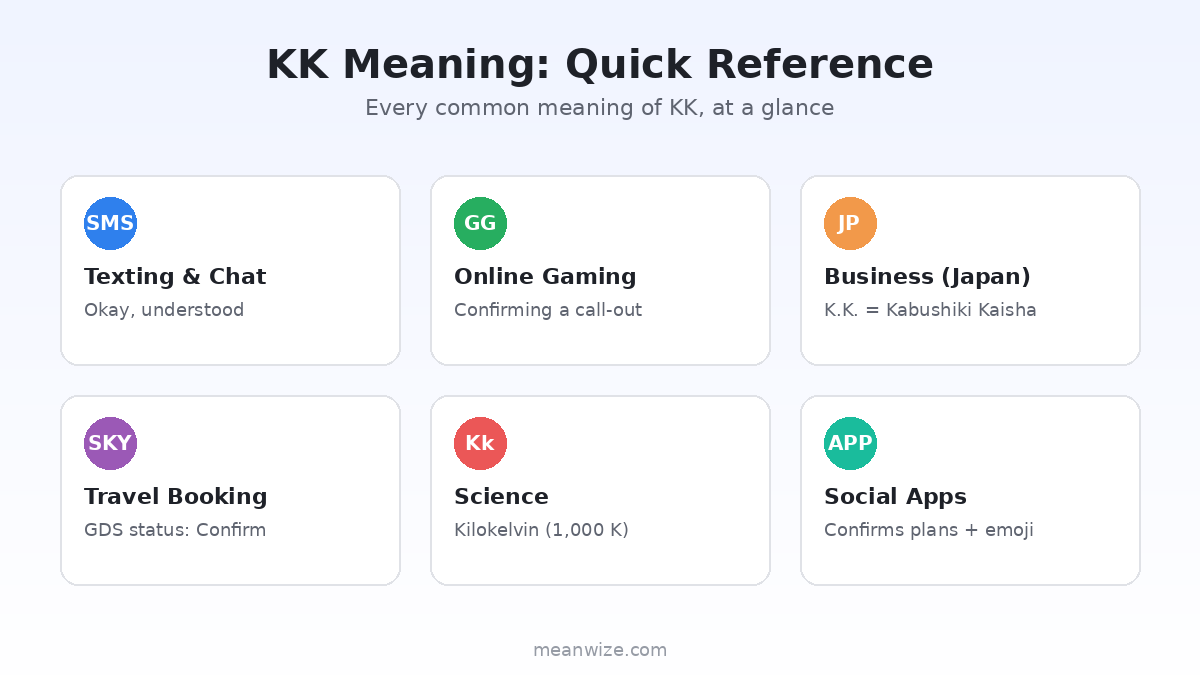
For most people searching “KK meaning,” the answer they want is the first one — the texting and chat definition. The other meanings only apply in specific industries (Japanese business documents, flight bookings, scientific measurement) and are worth knowing but far less common.
Is KK Rude? K vs KK vs OK vs Okay
Short answer: the KK meaning here is almost never rude — “kk” is actually the safer, friendlier option compared to a single “k.” The real risk in texting is sending just “k” by itself, which many people read as cold, annoyed, or dismissive.
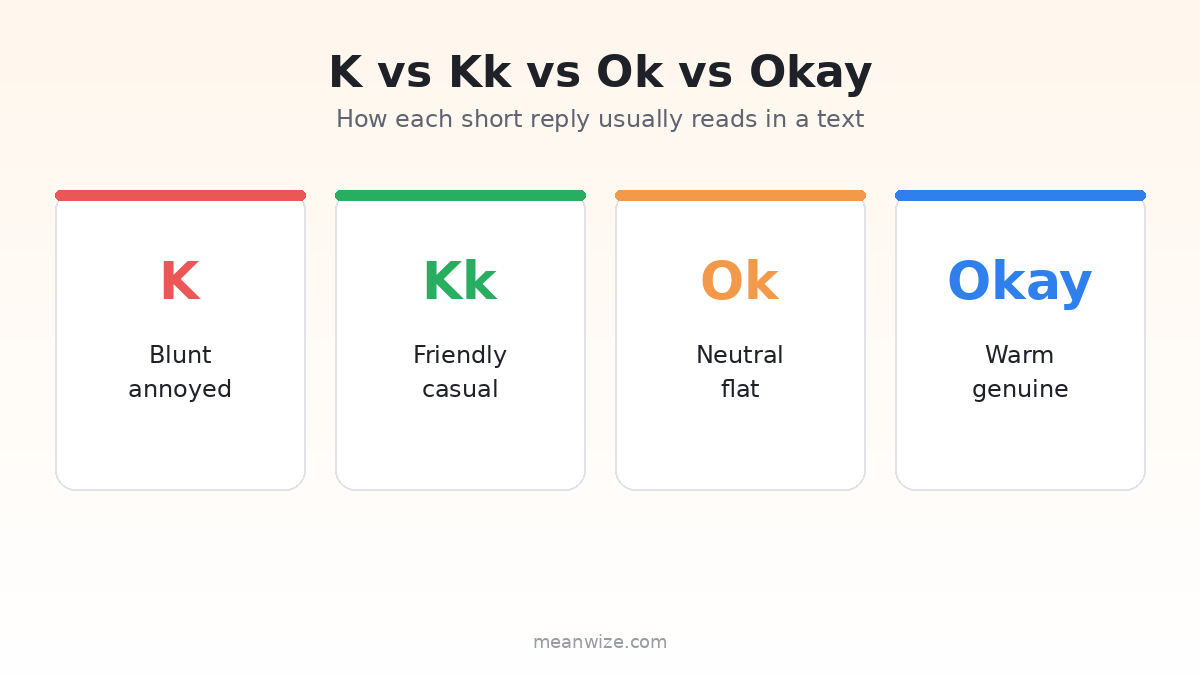
Here’s how the most common short replies compare in tone:
| Reply | How It Usually Reads |
|---|---|
| K | Blunt, often read as annoyed or angry |
| Kk | Friendly, casual, “no problem, got it” |
| Ok | Neutral, can feel a little flat or dismissive depending on context |
| Okay | Warmer and more deliberate — reads as genuine agreement |
| Okk / Okkk | Playful, informal, common with friends and younger users |
Tone in texting always depends on relationship and context. A single “k” from a close friend mid-conversation might mean nothing at all, while the same “k” after a disagreement can feel pointed. When in doubt, “kk” (or a full “okay”) is the lower-risk choice.
How to Use KK Correctly (With Examples)
Once you know the KK meaning, using it well is mostly about timing: it works best as a quick close to a conversation — not as an opener or a reply to something emotional.
Confirming plans:
“Meeting at 7pm at the usual spot” → “kk see you there”
Acknowledging instructions:
“Send the file by end of day” → “kk on it”
Casual agreement between friends:
“Bringing snacks, you get drinks?” → “kk got it”
Where to avoid it: skip “kk” when replying to something serious, emotional, or when a client/manager needs a clear, professional response — “Sounds good” or “Understood” reads better in those situations.
Why “KK” Feels Different From Just “OK”
The KK meaning and the “OK” meaning overlap almost completely — both say “yes, understood” — but they don’t feel the same, and that’s on purpose. “OK” is a complete word with a long history; typed on its own, it can read as clipped or neutral, the texting equivalent of a flat tone of voice. Doubling the letter into “kk” strips out that formality and replaces it with something closer to a verbal nod — which is really the whole KK meaning in one sentence.
Linguists call this kind of repetition “reduplication,” and it shows up across casual speech for the same reason every time: saying something twice signals warmth, emphasis, or reassurance rather than just information. “Kk” borrows that same trick in two keystrokes, which is exactly why it reads as friendlier than “ok” even though the two mean the same thing on paper.
How to Respond to “KK”
Most of the time, once the KK meaning has landed, it doesn’t need a reply at all — it’s already the closing message in a conversation. If you do want to respond, matching the energy works best:
To keep it casual: a 👍 or “yep” mirrors the tone without restarting the conversation.
To confirm something time-sensitive: a short “great, see you then” adds clarity without sounding stiff.
To start a new topic: skip acknowledging the “kk” altogether and move straight into your next message — re-confirming a confirmation just adds noise.
Common Mistakes to Avoid With “KK”
Even once you know the KK meaning, a few habits can make it land wrong. Here’s what to watch for:
Forgetting the KK meaning shifts with tone.
The same two letters can read as warm or clipped depending on punctuation and timing — pairing “kk” with an emoji or a follow-up sentence keeps the friendlier reading intact.
Using it to close a serious conversation.
“kk” reads as light and casual, so ending a heavier discussion with it can come across as dismissive — even though that’s rarely the intent.
Sending it to someone you don’t text often.
With new contacts, coworkers, or clients, “kk” can read as overly familiar before you know their texting style. “Sounds good” or “Got it” is a safer first move.
Assuming everyone reads it the same way.
Some older or less texting-fluent recipients may not know the KK meaning at all, or may read the doubled letter as an autocorrect typo rather than intentional slang.
Mixing it up with “K.K.” in written documents.
In business or travel contexts, “K.K.” (Kabushiki Kaisha) or a booking status code means something entirely different — context makes the difference clear, but it’s worth double-checking in formal writing.
Repeating it too many times in one chat.
One “kk” reads as a friendly close. Sending it two or three times in a row can come across as sarcastic or impatient rather than agreeable — save the doubled letter for the moment the conversation actually wraps up.
Similar Slang Terms to KK
“Kk” belongs to a small family of short acknowledgment terms that all do roughly the same job — confirm something quickly without over-explaining.
| Term | Meaning |
|---|---|
| Np | No problem |
| Sure / Yup | Casual agreement |
| Got it | Confirms understanding |
| Brb | Be right back |
| 👍 | Non-verbal “okay,” often replaces “kk” entirely |
Emoji reactions have started replacing “kk” in apps like WhatsApp and Instagram, since a thumbs-up or checkmark reaction confirms a message without typing anything. If you’re decoding other quick chat replies, our guides on FR meaning and SMH meaning cover two more of the most common ones.
Does KK Mean the Same Thing on Every App?
Mostly yes, but the way people reach for “kk” shifts a little by platform. On iMessage and WhatsApp, where read receipts already show a message was seen, “kk” (or a reaction emoji) is often the fastest way to close the loop without opening a full reply. In gaming voice chat and Discord, “kk” doubles as a quick callout confirmation between rounds, said or typed just as often.
Workplace tools like Slack and Teams are the one place the KK meaning gets risky: it reads fine in a casual team channel, but a quick “sounds good” or a 👍 reaction is the safer default in a client-facing or formal thread. And generationally, the pattern is simple — Gen Z leans more on emoji reactions to skip typing altogether, while Millennials and older texters are more likely to still type out “kk” by hand.
Is KK Still Used in 2026?
Yes — the KK meaning hasn’t changed, and “kk” remains one of the most common short replies across texting and messaging apps, especially among casual and younger users. Its usage has shifted slightly, though: reaction emojis (👍, ✅) on WhatsApp and Instagram now cover some of the same “quick acknowledgment” role that “kk” used to handle alone.
Even so, “kk” hasn’t gone away — it’s still the default fast reply in group chats, gaming voice chat, and casual conversations where a full sentence would feel unnecessary.
Related slang: If you found this helpful, also check our guide on sus meaning in text.
FAQs
Does “kk” mean someone is mad at you?
No. “Kk” is generally read as friendly and casual. A single “k” is more often the one associated with annoyance or a curt tone — “kk” is the softer, safer version. If you’re unsure, the rest of the message usually gives it away faster than the “kk” itself does.
What’s the difference between “k” and “kk”?
“K” is a one-letter reply that often reads as blunt or dismissive. “Kk” doubles the letter to sound more relaxed and agreeable — closer to “okay, no worries” than a flat “yes.”
Is it unprofessional to text “kk” at work?
In casual team chats with close coworkers, it’s usually fine. With clients, managers, or formal communication, “understood” or “sounds good” reads more professional. When in doubt, match whatever tone your manager or client already uses with you.
Should you use “kk” in professional emails?
No. The KK meaning is built for casual, real-time chat — it reads as too informal for email. Stick with “Understood,” “Noted,” or “Sounds good” in professional written communication.
What does K.K. mean after a Japanese company name?
It stands for Kabushiki Kaisha, the Japanese legal term for a stock company — roughly equivalent to “Inc.” or “Corp.” in English-speaking countries.
Why do people double letters like “kk” in texting?
Repetition softens tone. Doubling a short word or letter (“kk,” “no no,” “yes yes”) is a common casual-speech pattern that signals reassurance or agreement rather than a blunt, single-word answer. You’ll see the same pattern in spoken English too, not just texting.
Is “kk” the same as “okk” or “okkk”?
They’re close in meaning but slightly more playful. “Okk” and “okkk” are informal variations popular in casual and younger texting culture, carrying the same “okay, got it” meaning as “kk.”
Is “kk” Gen Z slang or older?
Older. The KK meaning traces back to early-2000s instant messaging, well before Gen Z was texting — it’s one of the few slang terms that’s stayed consistent across Millennials, Gen Z, and even some late Gen X texters.
Conclusion
The KK meaning comes down to one simple idea: it’s a faster, friendlier way of saying “okay, I understand” — no explanation needed. The tone shifts depending on where you use it, but across texting, social media, and gaming, “kk” almost always means agreement, not attitude. The one-letter “k,” not “kk,” is the reply worth watching out for.
Want more plain-English breakdowns of texting slang and internet terms? Browse our full slang and meanings guide to decode the next confusing text before you reply.
